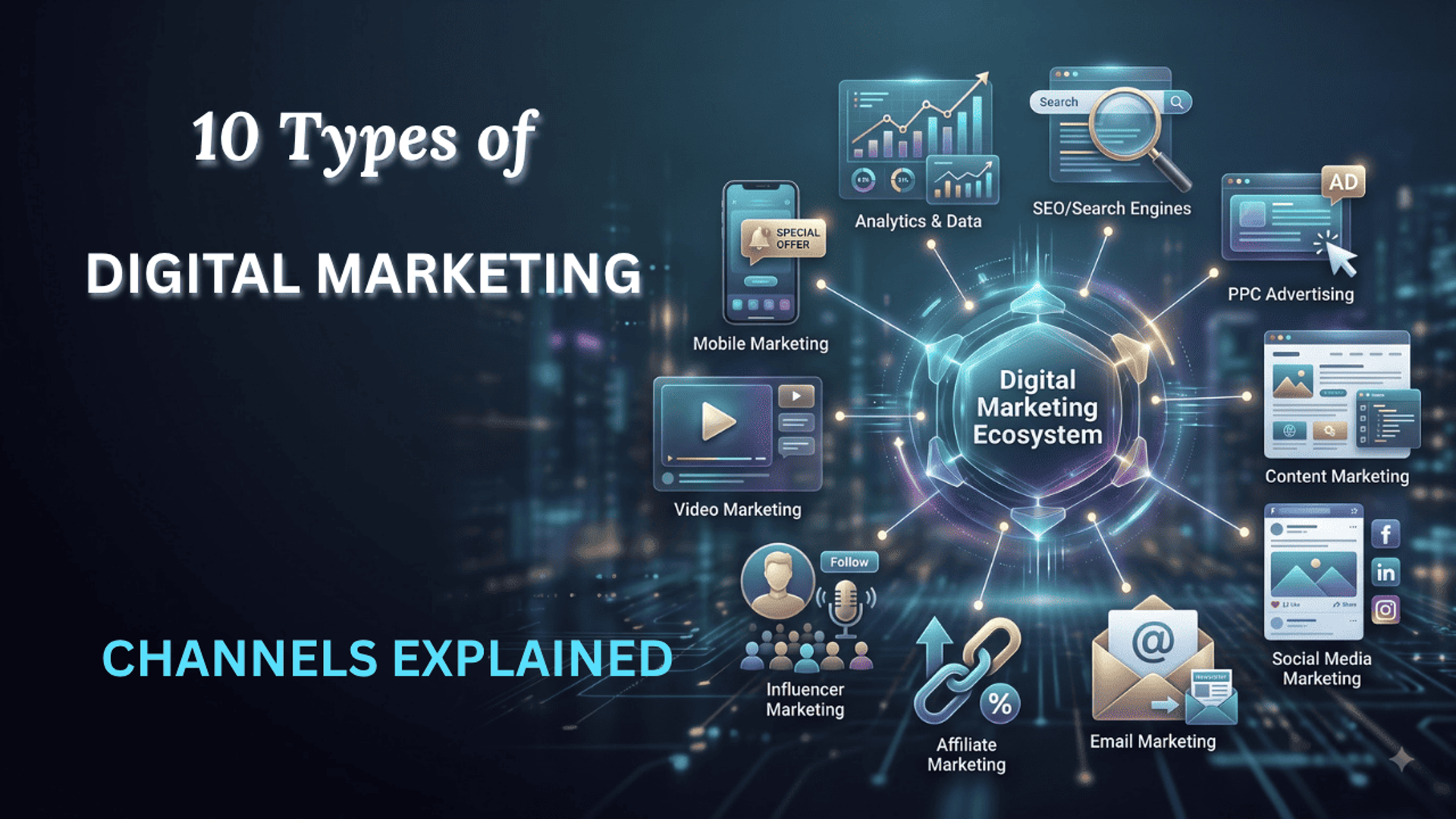
Digital marketing is not just a single, specific marketing method.
It is a combination of various strategies that businesses use to attract people, build awareness, generate leads, boost sales, and retain customers.
In the previous article, we explored what digital marketing is, its importance, and how businesses utilize various digital methods to reach their target audience.
However, when delving into digital marketing, a question naturally arises:
What are the different types of digital marketing, and how does each of them actually work?
There is no single, universal list that every marketer follows. Each business employs a unique mix of strategies tailored to its target audience, industry, and objectives.
Nevertheless, there are several key digital marketing methods that are important to understand.
Let us look at them one by one.
1. Search Engine Optimization (SEO)
SEO is the process of optimizing a website so that it appears prominently of search engines like Google, thereby attracting a large volume of organic (free) traffic from users searching for related topics.
For example, imagine you run a website that sells clothing.
Someone searches on Google for:
“Best online site to order women's clothing”
Google displays several websites in the search results. If your website appears there and the person clicks on it, they become a visitor to your site.
You do not have to pay Google for that specific click.
This is the fundamental goal of SEO: helping people discover your website when they search for the information, products, or services you offer.
SEO involves optimizing elements such as:
- Website content
- Page titles and descriptions
- Keywords
- Website structure
- Internal links
- Page speed
- Mobile user experience
- Technical issues
- External links
SEO generally takes time to build, but successful content can continue attracting visitors long after it is published.
In Simple Terms:
SEO helps your website get discovered through Google and other search engines.
2. Search Engine Marketing and PPC
Search engine marketing (SEM) is the practice of using paid advertising to make your business appear in search engine results. One of the most common forms is Pay-Per-Click (PPC) advertising.
Let’s assume you sell women's clothing.
You want your website to appear when someone searches for:
“Women's clothing”
Instead of waiting for your website to rank organically, you can create a paid ad that appears when people search for that keyword.
If someone clicks on your ad, you may pay for that click.
That is why it is called Pay-Per-Click (PPC).
A simple example
SEO:
You work to get your website featured in Google's organic (natural) results.
PPC:
You pay to have an ad appear in Google's advertising section.
Both can bring visitors from Google, but one focuses on organic visibility, while the other uses paid advertising.
In simple terms:
PPC helps you pay for visibility when people search for something related to your business.
3. Content Marketing
Content marketing is the practice of creating useful information that helps your target audience, rather than simply asking them to buy something.
This information could take the form of:
- Blog posts
- Guides
- Videos
- Tutorials
- Infographics
- Research papers
- Podcasts
- Newsletters
- A simple example
Imagine you are selling an SEO tool.
Instead of repeatedly saying:
“Buy our SEO tool.”
You could publish something like this:
“How to Conduct an SEO Audit: A Beginner’s Guide”
Someone looking for help with an SEO audit might discover your article.
They could learn something valuable from you and subsequently become interested in your SEO tool.
That is content marketing.
In simple terms: Content marketing involves providing useful information to people first, and then converting that attention into business opportunities.
4. Social Media Marketing
Social media marketing involves using platforms like Instagram, Facebook, LinkedIn, TikTok, and X to reach people, raise awareness, share content, and promote a business.
For example, imagine you run a digital marketing agency.
You could publish an Instagram post with a caption like:
“5 SEO mistakes that could be affecting your website.”
People interested in SEO might view, engage with, or share that post.
Some of them might then visit your website to learn more about your services.
Thus, social media can help businesses:
- Reach new audiences
- Build brand awareness
- Start conversations
- Share content
- Generate leads
- Increase website traffic
- Promote products and services
In simple term: Social media marketing is the use of social platforms to put your business in front of the right people and build relationships with them.
5. Email Marketing
Email marketing is a method of sending useful or promotional messages to people who have chosen to receive emails from your business.
For example, someone visits your website and likes your content.
They enter their email address—perhaps to subscribe to your newsletter or to access a free resource.
You can then send them:
- Useful articles
- Tips
- Product updates
- Special offers
- Newsletters
- Educational content
Imagine someone discovers your website today but isn't ready to make a purchase yet.
If they are on your email list, you have another opportunity to stay connected with them.
You can continue providing useful information until they are ready to become a customer.
In simple terms:
Email marketing helps businesses stay connected with people who have already shown interest in them.
6. Affiliate Marketing
Affiliate marketing is a method of earning a commission by promoting another company's product or service and having someone make a purchase through your unique referral link.
For example:
Imagine you run a website about digital marketing.
You write an article titled:
“10 Best SEO Tools for Small Businesses”
You recommend several SEO tools and include unique affiliate links for them.
A reader clicks on one of those affiliate links and purchases a tool.
The company then pays you a commission—a percentage of that sale.
Generally, three parties are involved in this process:
Company → Affiliate/Publisher → Customer
The company gains a customer.
The publisher earns a commission.
The customer finds a product that is useful to them.
In simple terms: Affiliate marketing involves recommending products or services and earning money when a sale or other qualifying action occurs as a result of your recommendation.
7. Influencer Marketing
Influencer marketing involves a company collaborating with an individual who already has an established audience to promote or demonstrate its product or service.
For example, imagine a company is launching a new SEO software product.
Instead of promoting it themselves, they could partner with a digital marketing creator whose audience is interested in SEO.
The creator could produce a video demonstrating how the tool works. They can use any social media platform; there are no strict rules regarding the choice of platform.
Their audience discovers the product through someone they already follow and trust.
And here is a crucial point:
A massive audience isn't always the best audience.
For an SEO company, a creator with 20,000 followers genuinely interested in SEO might be more valuable than someone with 500,000 followers who have no connection to the topic.
In simple terms: Influencer marketing is about leveraging the audience and credibility of relevant creators to introduce your product or service to potential customers.
8. Video Marketing
Video marketing involves using video to educate, demonstrate, entertain or promote products and services.
Video is now used across platforms such as YouTube, Instagram, TikTok and other video services.
Businesses can create:
Tutorials
Product demonstrations
Explainer videos
Customer stories
Educational videos
Webinars
Short-form videos
Brand storytelling
One of the interesting things about video marketing is that it can work together with SEO and content marketing.
For example, you could take one topic:
Technical SEO Audit
and create:
Blog article:
How to Perform a Technical SEO Audit
YouTube video:
Technical SEO Audit Tutorial
Short video:
3 Technical SEO Problems You Should Check Today
The topic remains the same, but the format changes depending on the platform.
When should you use video marketing?
Video can be particularly useful when:
A product needs demonstration
The topic is easier to explain visually
Your audience actively consumes video
You want to build a personal or brand presence
You want to repurpose existing content
9. Mobile Marketing
Mobile marketing involves reaching and communicating with customers through their smartphones and other mobile devices.
It includes the following:
- SMS messages
- Mobile apps
- Push notifications
- Mobile advertisements
- Mobile websites
- Location-based marketing
For example, imagine you have a shopping app.
You could send a push notification to users:
“Get a 20% discount on your favorite products now.”
The customer receives the message directly on their phone; clicking it takes them straight to the product, encouraging a purchase.
However, mobile marketing is not just about sending messages.
Your website must also function correctly on smartphones.
If your website is slow, difficult to navigate, or hard to read on a phone, you risk losing potential customers.
In simple terms: mobile marketing is about reaching customers through the devices they carry with them every day—specifically, smartphones.
10. Marketing Analytics
Marketing analytics is the process of collecting and analyzing marketing data to understand what works, what doesn't, and where improvements are needed.
Think of it this way:
Suppose you publish an article and 10,000 people view it.
That sounds great.
But what if only five of them actually become customers?
You need to understand what happened.
Analytics helps answer the following questions:
Where did the visitors come from?
Which pages did they visit?
Which keywords brought them to the website?
How long did they stay?
Did they click on anything?
Did they submit a form?
Did they make a purchase?
Where did they leave the site?
Tools like Google Analytics and Google Search Console help marketers understand different parts of this journey.
In simple terms:
Instead of relying on guesswork, marketing analytics enables you to use data to understand your marketing performance and make better decisions.
How Do These Digital Marketing Channels Work Together?
This is where digital marketing becomes truly interesting.
You don't have to choose just one channel and completely ignore all the others.
In real life, customers interact with a business multiple times before actually purchasing a product.
Let’s look at a simple example.
Imagine you run a small pizza restaurant.
You have recently opened the restaurant and want more people in your area to know about it.
Here is how different digital marketing methods can work together.
Step 1 — SEO (Search Engine Optimization)
Someone searches on Google for:
"Best pizza near me"
Your restaurant's website or Google Business Profile appears in the search results.
That person discovers your restaurant.
↓
Step 2 — Content Marketing
You publish useful or interesting content, for example:
"5 things that make our Margherita pizza unique"
That article explains your ingredients, the preparation method, and why your pizza stands out.
Now, that potential customer knows more about your restaurant.
↓
Step 3 — Social Media Marketing
You post photos and short videos of your pizzas on Instagram. You can showcase the following:
How the dough is prepared
A pizza coming out of the oven
Your most popular pizza
Customer reviews
Behind-the-scenes videos
Someone who discovered your restaurant via Google can now also view it on Instagram.
↓
Step 4 — Video Marketing
You create a short video showcasing:
"How we make our pizza—from dough to oven"
A viewer watches the video and becomes interested in tasting the pizza at your restaurant.
Video offers the customer something that text and images often cannot—a visual experience of the product.
↓
Step 5 — Email Marketing
A customer visits your website and signs up to receive special offers.
A few days later, you send an email:
"Get a 20% discount on your next pizza this weekend"
You now have another opportunity to bring that customer back.
↓
Step 6 — Paid Advertising
You run a local Google or social media ad promoting your weekend offer to people in your area.
Someone who hasn't discovered your restaurant yet might see the ad and visit your website. ↓
Step 7 — Analytics
You review your marketing data to understand what is happening.
For example:
How many people found you via Google?
How many people visited your website?
How many people came via Instagram?
How many people redeemed the offer? Which advertising campaign generated the most orders?
Now, you know which of your marketing activities are actually delivering good results.
What is happening here?
A customer doesn't simply buy a pizza the moment they see an advertisement.
Instead, they might interact with the business multiple times:
Google Search
↓
Website
↓
Article
↓
↓
Video
↓
↓
Offer
↓
Purchase
This is what makes digital marketing so powerful.
Various channels can work together to guide someone from discovering the business to becoming a customer.
Moreover, that journey doesn't end with the first purchase.
A restaurant can use email, social media, and useful content to stay in touch with the customer and bring them back.