Let’s be honest: AI was supposed to save us time. But if you are like most digital marketers and creators right now, you aren't saving time. You are spending four hours a day arguing with a chatbot, tweaking image prompts, and manually editing videos together.
You have just traded the grind of creating for the grind of prompting.
But if you look at the top 1% of creators—the faceless channels pulling millions of views, the niche site owners publishing 50 high-quality articles a week, the campaign managers running localized ads at scale—they aren't typing prompts into a web interface all day.
They are using a Hidden AI Workflow.
They have stopped treating AI as a "tool" and started treating it as an "autonomous system." Here is the exact, step-by-step workflow that top creators are using in 2026 to automate ideation, asset generation, and distribution without sacrificing human quality.
Phase 1: The Brain (Automated Trend Scraping)
Amateurs wake up, look at a blank screen, and ask ChatGPT, "Give me 10 video ideas about digital marketing." That is how you get generic, robotic content that gets zero clicks.
Top creators don't guess what to make. They use AI to scrape the internet for what is already going viral.
The Workflow:
The Context Heavyweight: Creators are using models with massive context windows—like Gemini 3.1 Pro—as their data analysts.
The Data Feed: Instead of asking for ideas, they download the last 30 days of YouTube transcripts from their top 5 competitors, plus the top-performing Reddit threads in their niche.
The Prompt: They drop this massive data file into the AI and prompt: "Analyze these 50 transcripts and Reddit threads. Identify the 'Information Gaps'—topics people are complaining about or asking follow-up questions on. Generate 5 unique content angles that answer these exact gaps."
Result: You instantly have a content calendar backed by actual market data, not AI hallucinations.
Phase 2: The Architect (Scripting with Claude Opus)
Once you have the idea, you need the script. But if you use standard models for this, your script will sound like a Wikipedia article.
As we covered in our Coding AI Guide, Claude Opus 4.6 is the undisputed king of deep reasoning and architectural context. Creators are using it to write scripts that actually retain human attention.
The Workflow:
The Persona Prompt: Top creators use a "Master System Prompt" that defines their brand voice.
"Act as a cynical but highly experienced digital marketer. Use short, punchy sentences. Do not use words like 'realm,' 'tapestry,' or 'delve.' Use the PAS (Problem, Agitate, Solve) copywriting framework."
The Iterative Loop: They feed the trend data from Phase 1 into Claude and ask it to generate just the hook first. Once the hook is perfect, they ask for the outline. Once the outline is approved, they ask for the full script.
Result: A script that reads like a human wrote it, structurally optimized for audience retention.
Phase 3: The Asset Factory (Visuals & Audio)
This is where the magic happens. You have the script, now you need the media. Top creators separate the audio and visual workflows using specialized models.
The Audio (ElevenLabs & NotebookLM)
We already know that Fake AI Podcasts are dominating 2026. Creators are taking their Claude Opus scripts and feeding them into ElevenLabs for precise, emotional voice cloning, or into Google NotebookLM for automated, multi-speaker banter.
The Visuals (Kling 3.0 + AI Image Generators)
Nobody is using generic stock footage anymore.
They use tools to generate hyper-specific, custom base images.
They feed those images into Kling 3.0 to generate 5-second, ultra-realistic video loops (like the Viral Broadcast Trend we broke down earlier).
Because the prompts are highly specific, the B-roll perfectly matches the audio script, creating a visually mesmerizing loop that traps the viewer's attention.
Phase 4: The Invisible Manager (Make.com Automation)
This is the true secret of the 1%. Up until this point, you are still manually downloading audio files and generating images. To scale, you must automate the connections.
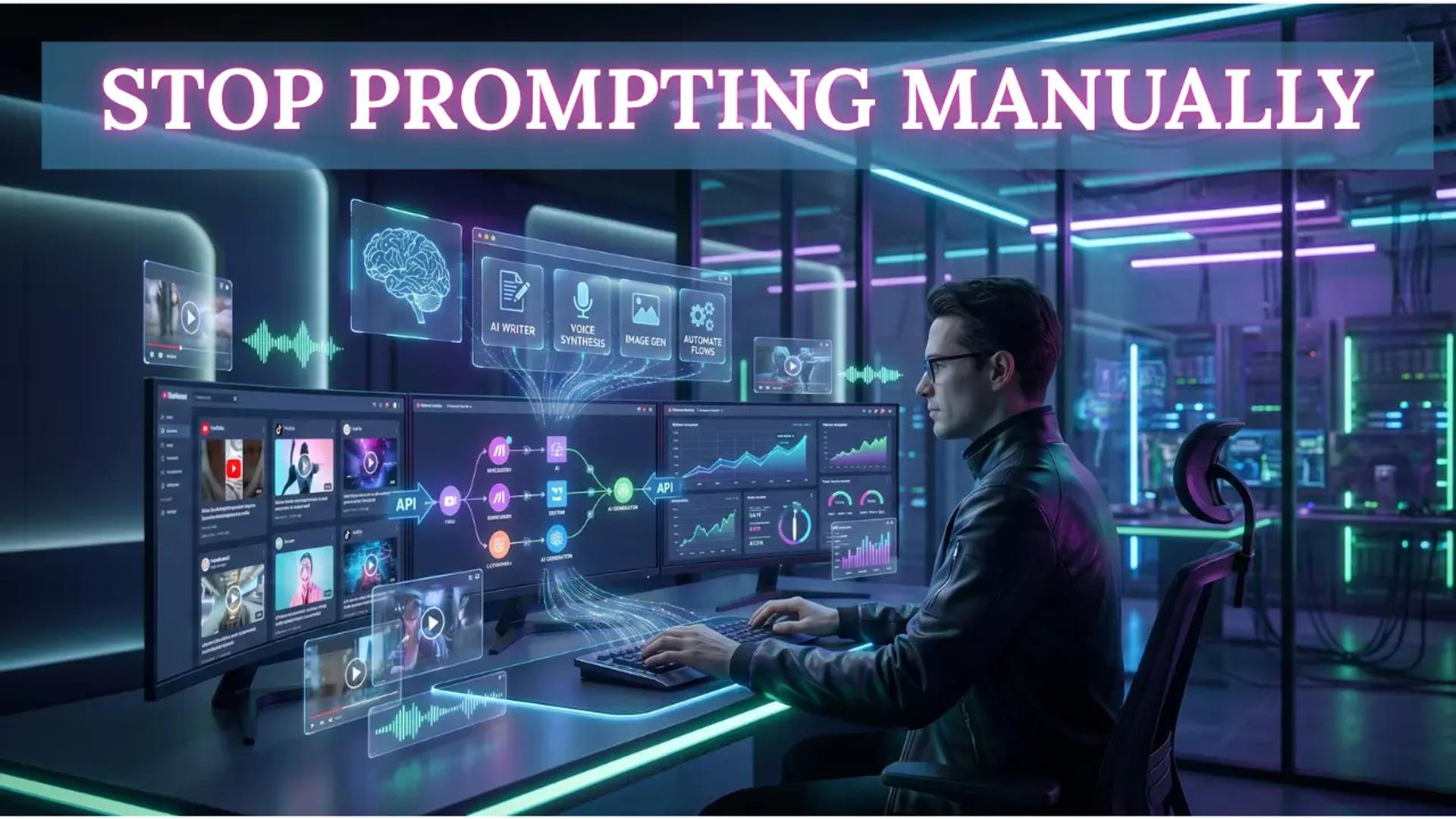
Top creators use Make.com (or Zapier) to tie the APIs of all these different tools together into a single, invisible conveyor belt.
The "Zero-Touch" Webhook Flow:
The Trigger: You drop a raw idea into a specific Notion database or an Airtable spreadsheet.
The Chain Reaction: Make.com detects the new entry and automatically pings the Claude Opus API to write the script.
The Hand-off: Make.com takes the finished script and automatically sends it to the ElevenLabs API to generate the voiceover.
The Final Delivery: The audio file and script are automatically uploaded to a Google Drive folder, and a Slack notification pings your video editor (or an AI video assembler) saying, "New asset ready for assembly."
The creator never opened ChatGPT. They never logged into an audio generator. They just typed an idea into a spreadsheet and walked away.
The Takeaway: Build Systems, Not Prompts
The era of the "Prompt Engineer" is dying. The future belongs to the System Architect.
If you want to survive the content flood in 2026, you need to stop playing with individual tools in your browser. Start linking their APIs together. Build an assembly line where your only job is providing the creative spark, and the AI handles the execution from script to screen.