For years, digital advertising has primarily taken place on search engines, social media platforms, websites, and video sites.
Google Ads can easily place a business in front of someone searching for a specific product. Meta Ads help businesses reach people based on their interests and other signals.
Now, there is another space that marketers need to understand: ChatGPT.
ChatGPT Ads allow businesses to display their advertisements within the ChatGPT experience. The interesting aspect here is that these ads are not based solely on traditional keyword targeting. Instead, ChatGPT displays ads tailored to the user by considering the ongoing conversation and understanding what the user is trying to achieve.
For digital marketers, this creates a new way of thinking about advertising.
What Are ChatGPT Ads?
ChatGPT ads are paid advertisements that may appear within ChatGPT.
These ads are displayed separately from ChatGPT's responses and are clearly marked as advertiser-sponsored content. OpenAI states that advertisements never influence the responses generated by ChatGPT.
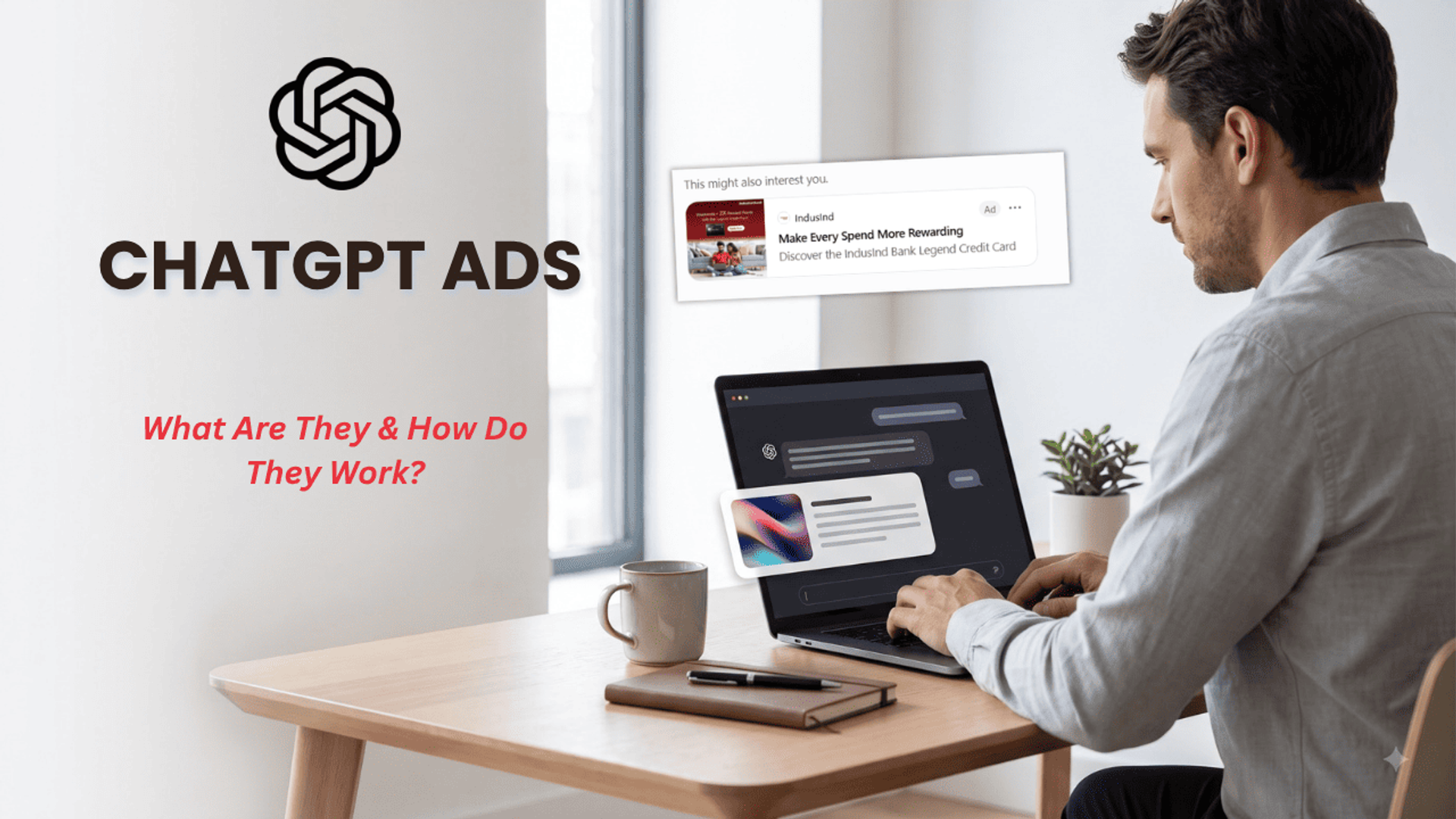
A typical advertisement may include the following:
Advertiser's name
Brand icon or favicon
Headline
Description
Image
Landing page
The advertisement appears in a small box below the ChatGPT response, rather than being inserted directly into the response itself.
If a user asks ChatGPT for advice on selecting a product, an advertiser cannot pay ChatGPT to recommend their product. Instead, the advertisement appears as a distinct, advertiser-sponsored placement.
Why Are Ads Coming to ChatGPT?
ChatGPT has evolved into a key destination where people do much more than just search for information.
People use it to compare products, conduct research, plan purchases, solve problems, learn new skills, and make informed decisions.
This makes the platform interesting from a marketing perspective.
OpenAI states that its advertising model is designed to reach people as they explore options, compare choices, and make decisions.
Consider the difference between these two searches:
Google:
Best accounting software for small businesses
ChatGPT:
I run a small business with five employees. We currently use spreadsheets for invoices and expenses. Which accounting software would make this easier?
The second interaction provides more context.
The user has explained the size of their business, their current solution, and the problem they are trying to solve.
That conversational context is one of the key factors distinguishing ChatGPT advertisements from traditional search ads.
How Does ChatGPT Decide Which Ad to Show?
ChatGPT does not select and display an advertisement to the user based solely on a keyword.
According to OpenAI, its advertising system considers several signals, including:
The context of the current conversation
The user's intent within that conversation
The advertisement's landing page
The ad's headline and content
Contextual cues provided by the advertiser
Some broad ChatGPT signals available when ad personalization is enabled
This does not mean that advertisers can view your private conversations.
OpenAI states that advertisers do not gain access to users' private conversations or personal details.
Who Can See ChatGPT Ads?
ChatGPT advertisements are currently part of an ad-supported service offering.
OpenAI states that ads may be displayed to users on the 'Free' and 'Go' plans. However, ads will not appear on Plus, Pro, Business, Enterprise, or Edu accounts. Ads will also not be shown on accounts belonging to users under the age of 18.
The advertising experience depends on the user's plan and eligibility.
ChatGPT Ads Are Still Developing
It is important to remember that ChatGPT Ads is a relatively new advertising platform.
OpenAI began testing ads in the US in February 2026 and is currently expanding the platform to additional countries while introducing new advertising tools.
The Ads Manager is also undergoing continuous improvement.
Businesses can now create advertising campaigns, set budgets and bids, upload ads, and measure performance through this platform. Current campaign options include CPM, CPC, and conversion-focused goals, subject to availability.
That means, the advertising experience we see today will not be the same as the one marketers will use a year from now.
ChatGPT Ads are still evolving, but one thing is already clear: digital advertising is moving beyond simple keywords and into a world where context and intent matter much more.